Friday, February 20, 2015

DAY 5 – INSPIRE Internship Programme 2015 Organized by Amity University Madhya Pradesh


FifthDay : 23 January 2015

The Fifth day of INSPIRE Internship Programme started with the felicitation of Dr. Ajay, Associate Professor, Department of Physics, IIT Roorkee. He inspired the students through the “Life achievements of Sir C.V.Raman and Raman Effects”. He inspired the students by tracing Sir C.V Raman’s scientific journey. This session was followed by the oral quiz session conducted by Dr. Vinod Bhatt, Amity University Gwalior. In this quiz, student of Army Public School Master Abhay Singh and student Jayesh Chaurasia from Ebenezer Higher Secondary won the first prize.

Valedictory Function : 23 January 2015
The programme ended with the Valedictory Ceremony which began with the traditional lighting of lamp and Saraswati Vandana. Hon’ble Vice Chancellor, AUMP Lt. Gen. V.K.Sharma, AVSM (Retd) presided over the function. Prof. Avinash Chandra Pandey, Hon’ble Vice Chancellor, Bundelkhand University, Jhansi was the Chief Guest. In the valedictory address, Esteemed Chief Guest Prof. Pandey presented the facts about Nano-Technology with numerous examples. In his concluding remarks, the Hon’ble Vice Chancellor, Amity University Gwalior Lt. Gen. V.K. Sharma asked the students to understand the fundamental concepts of science, so that the accepted theories can be challenged by future researchers. He strongly advised the students to work very hard to innovate and to take up new challenges in the field of science research and development. The winners of the quiz competition were given prizes by the Hon’ble Chief Guest and Guest of Honour. The Hon’ble Vice Chancellor felicitated the principals of the participating schools by offering mementos and participation certificate to the students. The vote of thanks was proposed by the Programme Coordinator of INSPIRE Internship Programme-2015 Prof. (Dr) Bikram K. Bahinipati of Amity University Madhya Pradesh. Student, Members from print and electronic media along with the faculty members of Amity University Madhya Pradesh were present on the occasion.

Feedback

The participants of the Inspire Internship Programme have been provided an opportunity to evaluate the infrastructural capacity of the organizing institute, boarding, lodging and logistics, interactive talks delivered by the mentors, practical demonstrations/ hands-on experience, scientific discussions with the mentors and the overall impact of the inspire Internship Camp. The programme was well appreciated by the participants from all the schools, whichis clear from the intern’s feedback report. Approximately 68 percent of thestudents termed the programme as “Outstanding”, 23 percent termed the programmeas “Very Good” and the 9 percent termed the programme as “Good”.

DAY 4 of INSPIRE Internship Programme 2015 Organized by Amity University Madhya Pradesh


Fourth Day : 22 January 2015

The Fourth day of INSPIRE Internship Programme started with the written science screening test for Quiz competition among the bright interns. The Quiz test was conducted under the active supervision of Dr. Iti Roychowdhury, Dy.Director-ASCENT of Amity University Madhya Pradesh and her team to shortlist the top eight participants for oral quiz session scheduled for the next day. The next session was mentored by Dr. B.S. Dwarakanath Scientist-D, Institute of Nuclear Medicine and Allied Science, New Delhi, who delivered an inspiring talk on “Ionising Radiations: Friends or Foe of the Mankind”. He motivated the students to take up the challenges of the research for developing applications of radiation technology. The post-lunch session was a field visit to DRDE, Gwalior, wherein the participants visited various high-tech research labs, such as Synthetic Chemistry Lab, Vector Management Division, Microbiology Division,Discovery Centre, Viriology Lab and so on. The students were overwhelmed with the practical exposure and were bubbling with energy while interacting with the eminent scientists of DRDE throughout the visit.

Thursday, February 19, 2015

DAY 3 – INSPIRE Internship Programme 2015 Organized by Amity University Madhya Pradesh

Dr. GS Sodhi, from Dept of Chemistry & Forensic Science, SGBT khalsa College, Delhi University talking on Importance & Role of Forensic Science in Crime Detection
Third Day : 21 January 2015

The third day of the INSPIRE Internship Programme started with the welcome and felicitation of the Mentor Dr.M. Boopathi, Scientist-E, DRDE, Gwalior. He delivered a talk on “Defence against Chemical Warfare”, while motivating the participants to take up careers in science and research. The next session was mentored by eminent Professor of Physiology, Dr.H.N. Mallick, from AIIMS, New Delhi. He delivered a talk on “Discovering:The secrets of sleep”. Grappling with sleep’s mystery and its insights, Dr. Mallick motivated the students towards the study of brain science and inspired them to be clear and precise in questioning the problem. He asked the students to think simple and develop a habit of digging throughout the studies, which may lead to research. The post lunch session was mentored by Dr.G S Sodhi from Deptt. of Chemistry & Forensic Science, SGTB Khalsa College,Delhi University, delivered a talk titled “How Forensic Chemistry helps in Combating Crime”, He presented the various perspectives of figure print development techniques, which can detect even the faintest finger prints clear and sharp. His talk was followed by the most exciting hands-on sessions on “Forensic Science”.

DAY 2 – INSPIRE Internship Programme 2015 Organized by Amity University Madhya Pradesh


Second Day : 20 January 2014

The second day of the INSPIRE Internship Programme started with the welcome and felicitation of the Mentor Prof. (Dr.) R.S. Tomar, Professor and Head, Amity Institute of Biotechnology and Dean Academics, Amity University Gwalior. He delivered a talk on“Biodiversity and its consequences”. He stressed on the role of biotechnology in maintaining the biodiversity and motivated students to work to develop biotechnology for the sake of society.

The next mentor of the day was Prof. (Dr) S.P.Bajpai, Dean Research, Amity University Gwalior. He addressed the participants on the topic “Environment and its challenges”. In his address he proposed various counter measures to protect the environment for a better tomorrow. He made students realize their role in maintaining the environment. The next mentor of the session was Prof. D.L. Sapra, Professor, Amity School of Science and Technology, Amity University Madhya Pradesh, Gwalior. In his lecture titled, “Science Technologies and Growth” he stressed on development of concepts through observation. He captivated the audience by number of practical examples and demonstrations. Post lunch session began with the Inspiring lecture on "Science and Innovation" by Prof.(Dr.) Pankaj Shrivastava from Department of Physics, ABV-IIITM, Gwalior. He stressed on the need to develop the potential brains to think and innovate for the beneficial development of society. In the last session of second day Prof. Joydeep Dhar, Department of Applied Mathematics, ABV-IIITM, Gwalior, presented a motivating lecture on “Fascinating Mathematical World” wherein he emphasized on importance of mathematical modeling for quantification of any observation.

Wednesday, February 18, 2015

DAY 1 of INSPIRE Internship Programme 2015 Organized by Amity University Madhya Pradesh


Lt Gen VK Sharma, AVSM (Retd), the Hon’ble Vice Chancellor, AUMP addressing the gathering
Floral Welcome of Dr. W. Selvamurthy, President (Honorary), Amity Science Technology & Innovation Foundation & Chairperson for Life Science, Amity University Noida and the Chief Guest of the Inaugural Session

Dr A. Mukhopadhyay, Staff Scientist – VII, National Institute of Immunology, New Delhi talking on Cell Biology


General

Amity University Gwalior organized a five day Inspire Internship Programme from 19-23 January 2015. The aim of the programme was to encourage the brilliant young minds to the study of basic sciences and technology at an early stage and select R&D as a career. The programme was sponsored by the Department of Science and Technology (DST) Govt. of India, New Delhi. The bar of eligibility for the students participants was fairly high, with students scoring more than 95 percent marks in ICSE or A1 grade in CBSE or 84.5 percent marks in MP Board in 10th class were eligible to participate. Approximately 200 students from 11 different schools of Gwalior participated in the events. The science teachers from various schools also participated in this INSPIRE Science Camp.

Inaugural Session and First Day : 19 January 2015

The Inaugural session started with traditional lighting of lamp and Saraswati Vandana. Inaugurating the programme, Hon’ble Vice Chancellor, Amity University Gwalior Lt Gen VK Sharma, AVSM (Retd) delivered the opening remarks and presented the importance of INSPIRE to the student participants. Dr.W. Selvamurthy, President (Honorary)-Amity Science, Technology & Innovation Foundation (ASTIF) and Chair Professor for Life Sciences, Amity University was the Chief Guest and key note speaker of the seminar. He delivered the keynote address on objectives of the science based research. He stressed that in order to improve the quality of life and combat hunger and diseases, the future researchers need to develop the next generation products and technologies, which can be achieved only by research in basic sciences. Dr. Selvamurthy encouraged and motivated the students to do what they love and enjoy a better living. He viewed that wonders can be achieved only by combining talent, technical skills, logical minds through proper human interfaces. Prof. (Dr.) S.G. Deshmukh, Director, ABV-IIITM, Gwalior was the Guest of Honour of the Inaugural Function.He delivered the address on “Nature Inspired Innovations”, he motivated students to observe and use nature’s design principles to innovate and learn to adapt. Next Mentor of session was Prof. R. K. Singh, Senior Principal Scientist and Deputy Director, Division of Toxicology CSIR – CDRI Lucknow. He motivated the audience through his talk on ”Safety Assessment of a New Male Anti fertility Injection- RISUG in India for 21st Century”. In Post lunch session, the students were inspired by mentor Dr.R.K. Sharma from Department of Mathematics, IIT New Delhi, by his lecture on “Mathematics in Daily life”. Emphasizing on role of symmetry, while playing with numbers and fundamentals of coding and decoding, he gave the tricks of solving puzzles to he participants. The last mentor of first day was Shanti Swarup Bhatnagar Awardee Scientist, Dr. Amitabha Mukhopadhyay of National Institute of Immunology (NII), New Delhi. He emphasized on the need to understand the biology of pathogens and develop a defence systems, which will destruct the pathogens like bacteria and virus on entering the human body. He motivated the students to take up careers in “Cell Biology” by presenting various perspectives and challenges. He focused on these perspectives through examples, and demonstrated the same through the hands- on -session.

Tuesday, February 10, 2015

Amity University Madhya Pradesh Organises Two Days National Seminar on Challenges to Indian Democracy - A Socio - Legal Perspective

Release of Book


The HODs, Faculties and Students of ALS with the Chief Guest Prof. A. Lakshminath, Hon’ble Vice Chancellor, Chanakya National Law University, Patna


The Amity Law School, Amity University Madhya Pradesh, conducted a two-day National Seminar: “Challenges to Indian Democracy– A Socio-Legal Perspective” on 29th & 30th January 2015.  Research papers from participants comprising research scholars, faculties, professionals and students were invited through brochures.  In response, the ALS received a number of abstracts and research papers, out of which 23 best papers were presented during the Seminar.  Renowned academician, who headed one of the top law schools in India, the NALSAR Law University, Hyderabad, and who is now heading the Chanakya National Law School,Patna, Prof. A. Lakshminath, Hon’ble Vice Chancellor, was invited to deliver the keynote address during the inaugural session of the Seminar.  Academicians of the Jiwaji University, Gwalior and the National Law University, Bhopal, and legal practitioners from the legal fraternity of the Hon’ble Bench of the Gwalior High Court were invited to be the resource persons of the Seminar.  A CD of forty abstracts on various topics received from the participants, and a book of sixteen selected research papers (with ISBN accession) were also released on the occasion. The proceedings of the Seminar were held at the University auditorium and the Moot Court Hall of the ALS.  The National Seminar was given a wide coverage by both the print as well as electronic media. The brochure and the poster of the National Seminar are enclosed.  A report on the Seminar is given below.

INAUGURAL SESSION

The two-day National Seminar: Challenges to Indian Democracy-A Socio-Legal Perspective was inaugurated on the 29thJanuary 2015 amidst pomp and gaiety by lighting of the lamp and recitation of Goddess Saraswati prayer by Hon’ble Vice Chancellor, Lt. General V.K. Sharma, AVSM (Retd), Prof. A. Lakshminath, Hon’ble  Vice Chancellor, Chanakya National Law University, Patna, Dr. Tapan R. Mohanty, NLU, Bhopal,  Prof. (Dr.) A.P.S. Chauhan, Head Department of Political Science, Jiwaji University, Gwalior, and Dr. Ch Narasimha Swamy, Dy Director, Amity Law School and Organising Secretary.  The HOIs/HODs, faculties, participants of the Seminar and students of the Amity University were present in the auditorium.

The dignitaries were felicitated by presentation of bouquets.

In his opening remarks, the Hon’ble Vice Chancellor had dwelt on the situation obtaining in the country in the last two decades and how poverty and corruption were challenging the Indian Democracy. Referring to the various aspects of governance, the Hon’ble Vice Chancellor stated that poverty is the main social hindrance to the Indian Democracy and if poverty is removed, the challenge will automatically be overcome.

KEY NOTE ADDRESS

Prof. A. Lakshminath, Hon’ble Vice Chancellor,Chanakya National Law University, Patna, the Chief Guest of the occasion,delivered the key-note address on the topic. Stating that the concept of democracy was a controversial one, he commented that democracy itself is a challenge to democracy.  He pointed out that there were discriminations at every level. If we were to face the challenges of democracy, one has to go the gross-roots level.  Referring to the functioning of democracy in India, he stated that of the four pillars of democracy none of them were functioning efficiently. Explaining in detail the challenges facing the Indian Democracy with respect of social and legal perspective, he stated that responsibility was on all of us, for the challenges were created by us and we ourselves have to find a solution to them.  He referred to the defending speech made by Edmund Burke on his impeachment. While referring to Jefferson’s role in the US Constitution and freedom of the Press, he quoted Mahabharata stating that the freedoms enshrined in the Constitution were not absolute and advocated that too much of anything should be avoided.  He was referring to RK Laxman’s cartoons projecting the common man and how sarcastically the cartoons were pointing out the vices of our rulers as also the Administration.

Dr Tapan R. Mohanty, Assoc. Professor, NLIU, Bhopal spoke on Women: A Critical Analysis of PC-PNDT Act, 1994.  It was followed by the speech of Prof. (Dr.) A.P.S.Chauhan of the Jiwaji University, who spoke on Democracy, Civil Society & Law.

RELEASE OF CD OF ABSTRACTS & BOOK

After the deliberations, the CD of the abstracts of the participants numbering 40 and the ISBN book with 16 papers selected for publication, were released by the dignitaries. Thereafter, mementos were presented to the Chief Guest, the Hon’ble Vice Chancellor and the guest speakers.

FIRST SESSION

The first session of presentations was held in the afternoon at the Moot Court Hall. The programme was chaired by Dr Tapan R Mohanty, Assoc. Professor, NLIU, Bhopal, and co-chaired by Dr Ch Narasimha Swamy, HOD/HOI, Amity Law School and Mrs. Bharti Sharma, Faculty, ALS. Eight papers were presented in the first session.

After lunch, the Chief Guest, Prof.A.Lakshminath was interviewed by the Press led by Dainik Bhaskar. The Chief Guest opined that corporate positions and legal profession were the best options of career for the Law students.  Later on, the Chief Guest was also interviewed by the Amiradio under the auspices of the ASCO Department of the Amity University Madhya Pradesh, Gwalior.

SECOND SESSION
The second session the National Seminar commenced at the Moot Court Hall in the forenoon of 30th January 2015 at 1030 hours, during which there were 15 presentations by the participants.

It was chaired by Dr. Kondaiah Jonnalagadda, NLIU, Bhopal, Dr Ch Narasimha Swamy, Dy Director, ALS,and  Dr. M.K. Sharma, Sr. Advocate, Gwalior Bench of High Court.  

Dr. M.K. Sharma, Senior Advocate, Hon’ble Gwalior High Court spoke on Rule of Law..Hon’ble Vice Chancellor, Dean (Research),Prof. S.P. Bajpai, and Dean (Academics) Prof. Rajesh Singh Tomar attended the session.

THE VALEDICTORY FUNCTI0N

The valedictory function commenced at 1515 hours in the auditorium.  Dr Kondaiah Jonnalagadda, Asst. Professor, NLIU, Bhopal, spoke on Corruption & Violation of Human Rights.  It was followed by the speech of Ms. Anuradha Singh, Advocate, Hon’ble High Court,Gwalior Bench, who spoke on Women Empowerment.

The Hon’ble Vice Chancellor, AUMP, while making his closing remarks observed that if we want to fight corruption, its beginning is to be made by ourselves. He suggested that let us pledge not to give and take bribes.  Hon’ble Vice Chancellor also thanked Prof. A.Lakshminath for gracing the National Seminar and delivering the keynote address.

Thereafter, Dr C N Swamy, Dy Director, & Organising Secretary submitted the consolidated report on the Amity Law School.  Dr Swamy observed that the Amity Law School was leaving no stone unturned in creating the awareness among the students to develop good English language base as all ‘Law’ is in that language, and also keep themselves abreast of what is happening in the society, State and the international arena, as Law is all about human beings and the world.

Later on, certificates were presented to Ms. Titasha Banerjee, Faculty, and Ms. Deeksha Goklani, student, being the Best Speakers selected among the presentations made on the eve of the Seminar.  Mementos were also presented to the guests of the afternoon session Dr Jonnalagadda Kondaiah, Asst. Professor, NLIU. Bhopal,and Ms. Anuradha Singh, Advocate, Hon’ble Gwalior Bench of the High Court.

VOTE OF THANKS

The National Seminar ended successfully with the vote of thanks proposed by Mr. Abhinav Upadhyay, the Convener of the Seminar.  The Convener thanked Hon’ble Vice Chancellor for all the encouragement and guidance, the Administration for the logistics,the ASCO for their cooperation in planning, the Chief Guest for the keynote address and the faculties and the students for making the National Seminar a grand success.

The Chief Guest Prof. A. Lakshminath, Hon’ble Vice Chancellor, Chanakya National Law University, Patna delivering his key note address

A token of remembrance
                               
Prof. A.P.S. Chauhan, Dept. of Polytical Science, Jiwaji University, Gwalior delivering his talk


Hon'ble Vice Chancellor Lt. Gen. V.K. Sharma, AVSM (Retd) addressing the gathering


Mr. Tapan R Mohanty, Associate Professor NLIU, Bhopal delivering his talk

Presentation of Certificate to the Best Speakers

Participants during the seminar

Friday, February 6, 2015

Amity University Madhya Pradesh Organized 'Principal's Conclave- 2015'

Amity University understands the role of teachers, school managements and parents in the ultimate objective of nation building through the development of human resource. With the objective of broadly covering the issues related to the challenges faced by the students, and to give a deep insight into 'Opportunities for pursuit of Higher Education in India, options to students after 10 + 2'. Amity University Madhya Pradesh organised a one-day Principals' Conclave - 2015 on 23 January 2015.

Mr Sunil Bhalla, Principal, DPS School, Rairu, Gwalior moderating the talk

Participants during the conclave

Mr Rajat Pathak, Director Admissions and CRC proposing Vote of Thanks

Lt Gen V K Sharma, Hon’ble Vice Chancellor, AUMP welcoming Ms Nishi Misra, Principal Scindia Kanya Vidyalaya, Gwalior and the Guest of Honour of the conclave

Ms Nishi Misra, Principal Scindia Kanya Vidyalaya, Gwalior addressing the gathering

Lt Gen V K Sharma, Hon’ble Vice Chancellor, AUMP delivering his key note speech

The Vice Chancellor, the Principals and HOIs/HODs of AUMP

Participant Principals:

Ms.  Nishi Misra - SKV, Gwalior

Mr. Sunil Bhalla - DPS, Rairu

Ms. Rajeshwari Sawant - Gwalior Glory H.S.School

Dr. Shabana Rehan - Little Angels High School

Ms. Rekha Saxena - KV No.2

Ms. Rekha Sharma - Rishi Galav School

Mr. Munendra Singh - KV. No. 4

Dr. Manohar Sharma - Ebenezer School

Wednesday, February 4, 2015

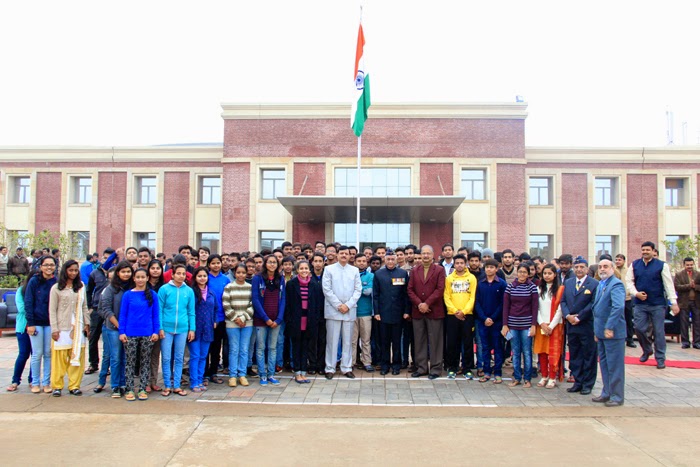
Amity University Madhya Pradesh, Gwalior celebrated the 67th Republic Day

Amity University Madhya Pradesh, Gwalior celebrated the 67th Republic Day of the country with great gaiety and fervor  on 26 January 2015.

Hon’ble Vice Chancellor, AUMP Lt Gen VK Sharma, AVSM (Retd) hoisting the National Flag on the 67th Republic Day

Hon’ble Vice Chancellor, AUMP Lt Gen VK Sharma, AVSM (Retd) addressing to the gathering
Hon’ble Vice Chancellor, AUMP Lt Gen VK Sharma, AVSM (Retd) interacting with the students
Patriotic fervor of AUMP
Amity Family with the National Flag


 The programme commenced with the hoisting of the National Flag by the Hon’ble Vice-Chancellor Amity University madhya Pradesh, Lt Gen V K Sharma AVSM (Retd) to the tune of the National Anthem.

Speaking  on the occasion, Gen Sharma  said that each citizen of the country, be it a student, teacher, guard, or helper, can contribute to nation building by discharging his/her duties diligently and honestly.   Gen Sharma  also said that  the need of the hour was to feel collective responsibility towards national welfare and development and work earnestly towards it.

The Hon’ble Vice Chancellor’s address was followed by a rendition of patriotic songs by staff and students which aroused  patriotic fervor amongst  the students, staff, members of faculty, Heads of Schools and Departments present on the occasion. The programme culminated with the distribution of sweets to all present.

Tuesday, February 3, 2015

Vastu As Science By AR.MONIKA S. GUPTA, Amity University Gwalior


VAASTU IS A SCIENCE AN ART OF LIVING IN HARMONY WITH THE NATURE. IT IS BASED ON RESEARCHES, INSTRUMENTS, DATABASE CASE STUDIES.

Vastu is the scientific study of directions, which aims at utilizing the natural energies that are available free of cost, for the benefit of humans, by creating an equilibrium between man and material. As a science, it extracts the positive energy from the natural elements of the universe - the panchbhootas, namely, earth, water, air, sun and sky. It all these five elements, for creating a congenial setting or a place to live or work in, in most the scientific way, exploiting the benefits bestowed by the five basic elements.
Vaastu is a science of balancing building with the laws of nature. A Vaastu friendly or nature friendly building is perfectly balanced with nature, subtle energies around and five elements. Now a days we are having National Building code, which gives us certain regulations to construct building, whereas in past our ancestors were having Vastu Shastra as a religious code.Vaastu is known as Sthapatya Veda or the Science of architecture. In the ancient period, Vaastu and architecture were one. Vaastu is in fact an architectural science which focuses on designing building considering the latitude, longitude and altitude of the place, climatology, land, location, subtle energies around and psychology of occupants.  There are lots of benefits easily possible through Scientific Vaastu. Sound sleep, efficiency, comfort level, relaxation, concentration, mental stability, strong immune system, better energy levels, fresh active feel and improved relationships are some of them. Vastu can be used for every room, every house, every temple, every shop industry, town planning, tour, cities and even for earth. Vastu can be used for micro as well as for macro level.
 Vastu shastra is based on various natural energies, which are available in atmosphere, mainly:

• SOLAR ENERGY
• COSMIC  ENERGY
• MAGNETIC ENERGY

1. SOLAR ENERGY  Every creature on earth starts its life with sunrise as it performs day & night. Hence there is much importance of sun in every one life. It gives ultra violet rays in morning and infra red rays in evening which one basic need to reduce / generate bio-chemical germs, N2/ Oxygen / CO2 on earth.
Sun indicates light (illumination) will power, generosity, solar system, luck or fate, mobility and in body. It rules over bone, eye, heart, spinalcord, blood circulation and soul etc. Hence east direction is auspicious; it belongs to lord Indra. North is considered auspicious since magnetic lines of forced moves from North to South, thus origin of all the life.
There are three forces in action to create harmony. Wind, water and fire or, vaayu, jal and Agni. If these forces are kept in their appropriate places, then there will be no disturbance. But if water is put in place of fire and wind in place of water or in any other combination, the forces will start acting accordingly and create disharmony and unpeacefulness.

2. COSMIC ENERGY OR ‘PRANA’
Prana is the Sanskrit  for “vital life”.. It is an auto-energizing force which creates a magnetic field and permeates each individual as well as the Cosmos at all levels. This self-energizing force is is the bond between the galaxies, the planets, humans and molecules which keeps the whole Cosmos in order. All beings are born through it and live by it. When they die, their individual breath dissolves into the cosmic breath.
It is surprising that the Vastu pundits of ancient times knew of this ‘life-force’ and so, “Prana” or the cosmic energy was considered an important Vaastu factor and taken into account while designing buildings. One of the goals of Vaastu in designing, is to restore balance between the building structure and the cosmos because when buildings echo the underlying cosmic principles, they vibrate in harmony with the universe and these vibrations affect the inmates in a positive way creating peace, prosperity and contentment in their lives.
Restore the balance of cosmic energy “prana” in buildings In Vastu, the movement of cosmic energy also called ‘prana’ through a 4-sided building is believed to be similar to the flow of energy across the Earth. It flows in a definite direction – from the North-East direction towards the South-East and North-West corners before heading to the South-West. Keeping this flow in mind, Vastu Shastra prescribes an ideal plan called the “Vastu Purusha Mandala” to ensure that the ‘prana’ or ‘cosmic energy’ moves smoothly through a building and around it. In the Vastu Mandala, the main entrance door is positioned  in the North-East to facilitate the entry of prana into the house from the North-East. Also, there is a central open court which facilitates the flow of prana into all the rooms.

3. THE MAGNETIC ENERGY
The Earth’s magnetic field is similar to that of a bar magnet with one pole near the geographic North pole and the other near the geographic South pole. The Earth’s magnetic field is mostly caused by convection of molten iron within the outer liquid core, along with a Coriolis effect caused by the overall planetary rotation, which organizes these “electric currents” in rolls aligned along the North-South polar axis. The magnetic energy flows out of the stronger magnetic North pole (near the geographic South) into the magnetic South pole. To avoid confusion just remember that the magnetic energy is stronger in the South and flows to the North.
‘Earth’s magnetic field’ an important vastu shastra factor Though geomagnetic storms have a negative effect on humans, on the positive side, it has been observed that the stronger magnetic North pole (Earth’s geographic South) has a positive effect on the body while the magnetic South pole (Earth’s geographic North) has a negative effect. The reason for this has not been scientifically explained.
One of the goals of Vastu in designing buildings, is to ensure that humans are constantly aligned in the right magnetic axis while they are inside the house, so that the Earth’s magnetic field has a positive effect on them rather than the opposite.

Vastu Shastra take into account the earth’s magnetic field in the design of structures
Some of the Vastu Shastra principles that ensure humans benefit from the positive effects of the Earth’s magnetic field are explained below. Since Vastu is a science, every guideline is based on logic and reasoning. As an Architect, I have attempted to explain these guidelines rationally and scientifically, so that you can decide what you want to follow and what you don’t.
One should never sleep with the head in the North. In fact it was said that only a dead body should be allowed to lie with the head in the North. To make it easy for us to remember, Vastu Shastra likened the Human body to a magnet with the Head as the North Pole and the feet as the South pole.  Therefore, if the head is directed towards the Earth’s North Pole, the two North Poles will repel each other and cause tension, disturbed sleep and other related health problems. So, the Vastu rule is that one should always keep the head away from the North while sleeping or sitting for long periods.  The Scientific Explanation - Since the Earth’s magnetic North pole (situated near the geographic South) is stronger and has a positive effect on humans, especially on their brains, one should always try to sleep or sit with the head in the South. Also, because the magnetic South pole (located near the Earth’s geographic North) has a negative effect, we must avoid sleeping with our heads in the North.
When sitting at the dining table or in the living room, one should sit facing East, North or West but avoid sitting facing South: The Scientific Reasoning - When you sit facing South,  your head is effectively in the North and your feet in the South. So, this causes the negative effect described above.
In the Puja room avoid idols facing North because then the worshipper has to face South which is not advisable. The Scientific Reason – When a worshiper sits facing South, his feet are towards the South and his head is in the North. This causes the negative effect explained above.
  

Wednesday, January 28, 2015

Amity University Gwalior to host film journalism festival Cineaste-2015


Film festival 'Cineaste 2015' related to media education and communication will be held on March 18 and 19 in Gwalior with prizes for short films including mobile films in the formats mov, .avi, .mp4, .wmv. Acceptable codecs are H.264 (MP4), MPEG-4, H.263, MPGV, and WMV, DivX. It is a film festival of its own kind for learning and research in mass communication and journalism with specialisation in film journalism.
In the festival organized by Amity School of Communication of Amity University in Madhya Pradesh, the entries of the films shorter than 20 minute duration either in colour or black and white with preferred format of HD 720p 16x9 have been invited. Short Films must be in the Hindi or English language or subtitled in these languages.

The entrants have been informed that their submissions should not contain any profanity, offensive language, obscene or otherwise objectionable material, the determination of which is solely at the discretion of Jury.
According to the organizers, the participants and the team must be present after the show for interlocution. Their films should be free from copyright issues and the film should be genuine. Mobile Films should not exceed five minute duration. The focus is to promote high quality media education and quality in journalism. The entries are being registered with a fee for review and finalization for the presentation during the festival, informed an invitation to me.
Film Journalism is an upcoming specialization in mass communication courses which involves making short films of events and happenings along with writing about films, film reviewing and interviewing. Graphic journalism is an emerging form with a colourful mishmash and intermixes of influences that include comics, infographics, film, and autobiography as a part of film journalism.

Tuesday, January 27, 2015

From Change Watcher To Change Leader By Asst. Prof. Rajiv Kumar Dwivedi Amity Gwalior


In today’s dynamic world the only thing which is constant is change. Being a part of any business environment you can never remain a change watcher as it is going to affect you sooner or later. Moment this thing is understood by any employee of an organization in real sense there will be three things which will happen to him. Either to accept the change happily, or to accept the change unhappily or not to accept the change. In the last case in which the employee does not accept the change, either he will have to leave the organization of his own or he will be fired from the organization creating a Lose- Lose situation for the employee as well as for the organization.  In the second case in which the employee accepts the change unhappily, he will be affected by the change but he is not happy. In this case the employee will not be motivated for long and he will not be fully engaged with the organization, at least the mental disengagement is bound to happen creating a Win – Lose for the employee and the organization which in long run will create a Lose – Lose situation for both the parties. Now taking about the first case in which the employee happily accepts the change. In this case the employee is happy, motivated and fully engaged mentally and physically with the organization and this is actually a Win – Win situation for both ie the employee and the employer (Organization).

Now once we know the best situation than why not to become a change leader and lead the change instead of mere accepting the change? Once we are able to understand this concept, we surely know that that the best way to manage a change is to lead the change. This can surely open new success avenues for all of us as well as not only can create a Win – Win situation but can create a Twin Win situation for both the employee as well as for the organization (organization).

Thursday, January 22, 2015

Emphasizing Agility in Medium Scale Manufacturing Industries -By Asst Prof Nasir Khan Amity Gwalior

In the past, economies of scale ruled the manufacturing world and everybody knew that mass production and full utilization of plant capacity was the way to make money. This style of manufacturing resulted in inflexible plants that could not be easily reconfigured, and were associated with swollen raw materials, work-in-process and finished goods inventories. Since the early 1980s, in pursuit of greater flexibility, elimination of excess in inventory, shortened lead-times, and advanced levels of quality in both products and customer service, industry analysts have popularized the terms `world-class manufacturing’ and lean production’ .
The aim is to generate a framework that will reduce wastes and subsequently increase the flexibility in production. Customer Demand Uncertainty including lean and agile paradigms has been widely investigated so far and there are available research studies regarding this area.


In the past, economies of scale ruled the manufacturing world and everybody knew that mass production and full utilization of plant capacity was the way to make money. This style of manufacturing resulted in inflexible plants that could not be easily reconfigured, and were associated with swollen raw materials, work-in-process and finished goods inventories. Since the early 1980s, in pursuit of greater flexibility, elimination of excess in inventory, shortened lead-times, and advanced levels of quality in both products and customer service, industry analysts have popularized the terms `world-class manufacturing’ and lean production’ .
The aim is to generate a framework that will reduce wastes and subsequently increase the flexibility in production. Customer Demand Uncertainty including lean and agile paradigms has been widely investigated so far and there are available research studies regarding this area.

To compete effectively in the global marketplace of the twenty-first century, manufacturing companies are trying to maintain a high level of flexibility and responsiveness to achieve agility and to remain competitive. Manufacturers are under tremendous pressure to improve productivity and quality while reducing costs. The new competition is in terms of reduced cost, improved quality products with higher performance, a wider range of products and better services all delivered simultaneously to enhance value to customers. In such environment providing good quality product at low cost for a medium scale industry has become very tough. To provide good quality product at low cost, small industries need a formulation of some manufacturing approaches like agile manufacturing to manufacture defect free products within their materials cost limit. Medium scale steel manufacturing industries are facing problems of higher rejections in form of wastes so as to increase their cost. This blog aims to analyze the application of agile manufacturing in Medium scale steel manufacturing industries in order to reduce wastages through implementing lean tools and techniques. An agility audit questionnaire is used for assessing the agility level of the company to identify the current level of performance within the company with respect to the key elements of agility. MSI’s agile experience is reported including a list of recommendation for improving its competitiveness to offer solution alternatives not only to the current problems but also to the ones that may be encountered in the future.

Once companies pinpoint the major sources of waste, tools such as continuous improvement, autonomous maintenance, just in time, fishbone diagram and others will guide companies through corrective actions so as to eliminate waste. Continuous Improvement is another fundamental principle of lean manufacturing. One of the effective tools for continuous improvement is 5S, which is the basis for an effective lean company. Japanese name of Autonomous maintenance is JISHU HOZEN. This pillar is geared towards developing operators to be able to take care of small maintenance tasks, thus freeing up the skilled maintenance people to spend time on more value added activity and technical repairs. Cellular manufacturing is one of the cornerstones when one wants to become lean. The Fishbone Diagram is an easy to use and effective cause and effect technique developed by Kauoru Ishikawa.

Tuesday, January 20, 2015

CLIMATE CHANGE, ITS EFFECTS & SOLUTION Prof. Y.P.Singh Amity University Gwalior


Climate change is already harming people and ecosystems. Its reality can be seen in melting glaciers, disintegrating polar ice, thawing permafrost, changing monsoon patterns, rising sea levels, changing ecosystems and fatal heat waves.

Scientists are not the only ones talking about these changes. From the apple growers in Himachal to the farmers in Vidharbha and those living in disappearing islands in the Sunderbans are already struggling with the impacts of climate change.
 This is just the beginning. We need to act to avoid terrible climate change. No one knows how much warming is "safe".


Early effects of small to moderate warming

• Rise in sea level due to melting glaciers and the thermal expansion of the oceans as global temperature increases.

• Massive release of greenhouse gases from melting permafrost and dying forests.

• A high risk of more extreme weather events such as heat waves, droughts and floods. The global incidence of drought has already doubled over the past 30 years.

• Severe regional impacts. Example: In Europe river flooding will increase and in coastal areas the risk of flooding, erosion and wetland loss will increase substantially.

• Natural systems, including glaciers, coral reefs, mangroves, Arctic ecosystems, alpine ecosystems, Boreal forests, tropical forests, prairie wetlands and native grasslands, will be severely threatened.

• The existing risks of species extinction and biodiversity loss will increase.

• The greatest impacts will be on the poorer countries least able to protect themselves from rising sea levels. There will be spread of disease and declines in agricultural production in the developing countries of Africa, Asia and the Pacific.

• At all scales of climate change, developing countries will suffer the most.

Solutions for the climate
• Make sure emissions peak in 2015 and decrease as rapidly as possible towards zero after that.
• Developed countries must make cuts of 40 percent on their 1990 carbon emisisons by 2020.
• Developing countries must slow the growth of emissions by 15-30 percent by 2020, with support from industrialised nations.
• Protect tropical forests with a special funding mechanism - forests for climate.
• Replace dirty fossil fuel energy with renewable energy and energy efficiency.
• Reject false solutions like nuclear energy.
Now a Lima Climate Change Conference - December 2014 held & made some decisions & Manuel Pulgar-Vidal, the Minister of the Environment of Peru and the COP President, said: 
Lima has given new urgency towards fast tracking adaptation and building resilience across the developing world—not least by strengthening the link to finance and the development of national adaptation plans.
He said. The Lima Climate Conference achieved a range of other important outcomes and decisions and "firsts" in the history of the international climate process.
• Pledges were made by both developed and developing countries prior to and during the COP that took the capitalization of the new Green Climate Fund (GCF) past an initial $10 billion target.
• Levels of transparency and confidence-building reached new heights as several industrialized countries submitted themselves to questioning about their emissions targets under a new process called a Multilateral Assessment.
• The Lima Ministerial Declaration on Education and Awareness-raising calls on governments to put climate change into school curricula and climate awareness into national development plans.

Friday, January 9, 2015

EXTREME BIONICS - Asso. Prof., Amity University, Gwalior


The best way to predict the future is to invent it. “Fifty years out, I think we will have largely eliminated disability”  patients spending  months in rehabilitation rooms trying out prosthetic legs, but they are not as good as flash and bone of normal human being. And hence are unacceptable. Surely, there will be a time when medical technologists could build replacement parts that wouldn’t slow them down.

The goal of the NeuroMechanics & Biomechatronics section of biomechanical engineering is to improve the quality of life humans with a movement disorder. We develop new interventions and diagnostic techniques based on fundamental insight in (impaired) human motor control. This is accomplished through the combination of computational modelling of the neuromechanial system and experiments using techniques from system and control engineering, such as closed loop system identification. This enables the development of devices to contribute to the improved diagnosis and treatment of participants with movement disorders."...
Technologist developed advanced prosthetics that can be used to walk, run, dance climb stairs and even go for mountaineering and rock climbing. Center for Extreme Bionics, is setting out not just to reinvent themselves but the whole of society. Physical disabilities will be a thing of past. It is not just physical disabilities but many emotional and intellectual infirmities as well.  The solutions lie not in biological or pharmacological cures but in novel electromechanical additions to our bodies. Scientists are part of a movement aimed at ushering medicine into a cyborg age. Engineers are building electronics-based systems that communicate directly with the human nervous system, promising radically new treatments for a variety of ailments and conditions, both physical and mental. While focus is more on giving people better control of their prosthetic limbs, it is equally possible to give patients better control of their emotions. One promising experiment targets depression with deep brain stimulation (DBS), in which electrodes implanted in the brain send steady pulses of electricity to certain problematic neural areas. Others area of development is to compensate for intellectual deficits & to build a memory-augmenting prosthetic.
Surprising range of afflictions can be most effectively treated by learning the electrical language that the brain uses to govern our movements, moods, and memories. It’s entirely possible that neural engineers may be fluent enough to mimic those instructions, allowing them to repair a human being’s faulty systems by rewiring them.
The body is electric. Neurons in the brain send out pulses of voltage when they “fire,” and the patterns of their pulses make up our sensations, our musings, and our actions. The electric signals generated in the brain also travel through the spinal cord and along the peripheral nerves to instruct the body’s muscles and organs. Medicine primarily relied on pharmaceuticals that could chemically alter the action of neurons or other cells in the body, but with the help of extreme bionics health care may be defined more by electroceuticals: novel treatments that will use pulses of electricity to regulate the activity of neurons, or devices that interface directly with our nerves.
Advanced prosthetic legs will allow amputees to control a titanium-and-plastic limb as naturally as they would a flesh-and-blood leg. The goal is to record and understand the brain’s commands and then to send those instructions to the prosthetic. Early version of such integrated devices are already under test, in that patients flexed the muscles around his knee as if they were taking a step; then an electromyograph captured the electric signal in those muscles and translated it into a digital signal that made sense to the microprocessors in his artificial foot. Even more direct connection between brain and machine will be possible, when one succeeds in connecting prosthetics directly to the peripheral nerves in amputee’s residual limbs. Not only could such a system relay more precise commands to the prosthetic, it could also send sensory information back up the nerves. And when amputees actually feel the grass beneath their prosthetic toes, it will change the way humans view this technology. When that happens it will not matter what [the prosthetic] is made of, it will be you.
The problem with traditional prostheses has always been that the wearer does most of the work, particularly when walking uphill or over uneven terrain. That may soon become a thing of the past. Bionic leg is a motorized, prosthetic system for transfemoral amputees. Technology is different because it works with, not against, the wearer. Unlike passive lower limbs, the new bionics knee is capable of both active flexion and extension, which makes it more energy-efficient and enables a more natural gait.  Sensors in the amputee's shoes send signals to the knee's computer, which reproduces the appropriate walking pattern. Whether you want to climb stairs, walk quickly or slowly, sit or stand, it recognizes it in real time. The new bionic limb is now working on a motorized ankle and artificial muscles, as well as a neural implant to replace the bionic leg's external sensors.
Seattle Systems, in conjunction with Sandia National Laboratories, is still working on a Smart Integrated Lower Limb (SILL). The final version will incorporate multiple sensors that feed data on pressure, position, and speed to a central processor that will control the knee as well as the ankle, foot and socket. The leg socket will adjust to the changing diameter of the wearer's residual limb over the course of a day. Pressure sensors in the foot will deliver a mild buzz to electrodes attached to the residual limb. Using these cues, amputees will be able to train their limb to “feel” their prosthetic foot as it hits the ground. The basic concept of the SILL is common to the schools of thought behind all bionics: An artificial limb, like a healthy one, should function as a unit, rather than a group of parts. This is the definition of bionic technology, in the truest, simplest sense, ’Total Integration’ - a direct link between human and machine.
People with bodily disabilities typically have crushing emotional difficulty of depression and often don’t know when it started. Depression is just the state of mind they live with daily, stripping the present of all pleasure and the future of all hope. Neuroscientists discovered that existential dread can be treated by using electricity to alter the activity of neurons, and they are now putting that knowledge to use DBS (Deep Brain Simulation) as one of the most exciting experimental treatments for depression, and uses an implanted “brain pacemaker” that sends steady pulses of electricity to certain brain regions. It’s a technology that was pioneered to stop Parkinson’s patients’ tremors, but it’s now being explored for a dizzying array of neural and psychiatric disorders, including depression, obsessive-compulsive disorder, and PTSD.
Parkinson’s patients have had electrodes implanted in the motor control regions of their brains, where the stimulator’s pulses reduce the activity of neurons that are misfiring. But for disorders like depression, both the target for treatment and the mechanism of action are considerably less clear. “The limiting factor is actually the neuroscience, not the engineering, brain imaging is used for studies to pinpoint a particular region, Brodmann area 25, as overactive in depressed patients, and implanted the DBS device in this region of the brains of patients who haven’t responded to a slew of medications and therapies. While antidepressant medications typically take weeks to kick in, many patients in the DBS experiments have reported a shift in mood instantly—literally the moment that the device is turned on. Most patients have chosen to keep their DBS systems activated after the formal experiments ended
There are many variables that can influence the effectiveness of DBS; even if the trial had targeted the correct region, the timing of the pulses may have been off. The neuroscience initiatives in brain engineering are trying to develop new tools that can better record and analyze brain activity. The Human Brain Project is using supercomputers to simulate a complete human brain so as to better understand how it functions. DBS and other electrical techniques will be part of mainstream psychiatry, Scientists try to know as much about the workings of a neuron as engineers do about the workings of an electrode. Once physical and emotional disabilities have been conquered, the intellectual failures associated with aging will be a natural next target. In fact, cyborg may simply be the sensible and economical thing to do. We’re living longer, so aging problems, and cognitive problems in particular, are going to be more and more prevalent.  It’s quite possible that Alzheimer’s patients will be equipped with memory prosthetics derived from the devices. Delicate electrodes inserted into a rat’s hippocampus, the brain structure responsible for encoding memory. The relationship between the input signals from neurons that process a brief learning experience and the output signals from neurons that send the information is deciphered  Once correlations has been mapped between the two electrical patterns, one could record an input signal and predict the output signal—in other words, the memory. Elderly people could have devices that they switch on to remember something as trivial as where they put their car keys or as meaningful as their grandchildren’s names.
Synthetic body parts could easily become more desirable than biological parts, especially as people age. Such physical and cognitive enhancements could benefit individual humans. While engineering will play a central role in future medicine, biological treatments will hardly vanish. Those treatments will be shaped by the coming ubiquity of cheap genome sequencing, which will enable a new model of personalized genetic medicine. The change will start in the maternity ward, where newborns in their bassinets will receive full genome scans, resulting in complete printouts of their genetic vulnerabilities. Then, as those babies grow up and proceed through life, their physicians can design custom-made health-care regimens to ward off trouble and can prescribe the medications that their bodies will respond to best.

Dr. SANJAY GOMASTA
Associate Professor
Mechanical & Automation Engineering
ASET- AMITY UNIVERSITY GWALIOR

Thursday, January 8, 2015

Amity University Madhya Pradesh Organizes Workshop on Conduct of Personal Interviews (PI) of Students for Amity Common Admission Test

Amity University Madhya Pradesh organized a one day  Workshop on 6 Jan 2015 on the topic ‘Conduct of Personal Interviews (PI) of Students for Amity Common Admission Test (AMCAT)’.

Hon’ble Vice Chancellor, Lt Gen V K Sharma, AVSM (Retd) explaining the purpose of the Workshop
The participants engrossed in the questionnaire

Dr Iti Roy Chowdhury, Dy Director, ACSENT, taking a session on the purpose of PI

The Workshop began with the address of Hon’ble Vice Chancellor AUMP, Lt Gen V K Sharma, AVSM (Retd). Speaking on the occasion Gen Sharma said that it is essential to formalize and structure the PI process for greater efficiency and effectiveness. Further, he said that, not only would the Faculty members gain inputs on verbal and non verbal communication and method of evaluation but the Workshop would  create synergy that  would enable all faculty members to conduct the AMCAT PI  in a professional manner.

The Workshop  was spread over five sessions. The first session on the ‘Purpose of PIs’ was conducted by Dr Iti Roychowdhury,  Dy Director ASCENT. The session involved a point wise debate on PI Questions- the what , how, which etc. The audience was divided into groups and were asked to come to a consensus over the  points raised in the Questionnaire.

In the II session Ms Jeanne Wilfred Vaz,   Dy Director Admissions, explained the duties  of invigilators as also those of PI panelists and GD Evaluators during AMCAT. She also spoke on the documentation and assessment components of AMCAT.

Ms Sudha Mishra, Asstt Prof, ASCENT,conducted a session on Assessment of Communication Skills during the Workshop. Her session involved a role play that showcased the skills that are required for communication. She then stressed on the aspects of communication that ought to be assessed during the PI.

The post lunch session was that of Dr Deepa Pandey, HoD, AIBAS. Dr Pandey spoke on the Assessment of the candidate’s Attitude and Behaviour. She stressed on the importance of attitude assessment because an incorrect attitude troubles the students throughout his/her stay in the campus.

The last session of the day was  conducted by Mr Amanpreet Randhawah, Asstt Prof ASCENT. His  topic was Assessment of Value Added Qualities and Feedback. This session invited debate on counseling and feedback during the PI.

The Workshop was attended by all members of Faculty of AUMP and generated a lot of discussion – leading to a greater clarity about the AMCAT PIs in the minds of the prospective PI Panelists of AMCAT.